

Beginning of 1945, Upper Silesia, Poland. The last days of WW2. At the just liberated areas, the Communist Security Service eliminates its enemies under the pretext of punishing “national traitors.” It organizes a labour camp for Germans, Silesians and Poles, at the site of a former Nazi concentration camp, which is named “Zgoda” / “Reconciliation”. Franek, who is in love with a Polish prisoner Anna, joins the camp crew to rescue her. He doesn't know that one of the inmates is Erwin, his German friend, who, like himself, has also loved Anna for a long time. Franek joins Communists in the illusory hope of outsmarting the system.

A touching but at the same time funny story about two sisters, who, despite mutual grievances, are forced to cooperate when faced with a difficult life situation. These Daughters of Mine is a heart-warming, honest and profound story about family relations. It is as true as life: sometimes sad, sometimes funny.

Marianna is an attractive 40-year-old woman. She once walked out on the people she loved. She sued your own parents. Does that sound like something you would do? What if It was the only way for you to change your birth certificate? Change your sex? Be yourself? Step by step, we are slowly drawn into Marianna's life in order to understand the difficult decisions she had to make. The film about Marianna has two dimensions. One focuses on a staged theatrical level, in which she confronts her past. The other is purely documentary, in which she struggles with unexpected situations that have a huge impact on her life. As it turns out, life wrote a new, completely unpredictable script for Marianna. The price of freedom and long-desired female identity ended up being very high. (Documentary - 75 min)

Toys takes a look at the circumstances which shaped the imaginations of today's generation of Polish artists and designers.
‘Hakawati’ in the Arab tradition is a master of storytelling, a brilliant raconteur who tells stories to everybody willing to listen. Hakawati played a very important role in the Arab culture: they gathered crowds of people eager to hear new fairy tales and strange stories. And now there are no real Hakawati left. In the contemporary world people have no time to listen to stories. The director sets off to search for true storytellers and finds the remnants of the tradition, which, unfortunately, are rather for camera‑holding tourists than local people.
written and directed: Paweł Józwiak – Rodan cinematographer: Anna Rzepka, Paweł Józwiak – Rodan edited by: Agnieszka Kowalczyk production manager: Maciej Domagalski producer: Piotr Śliwinski (Studio Filmowe Kalejdoskop), executive producers: Studio Filmowe Kalejdoskop production: Studio Filmowe Kalejdoskop, Telewizja Polska S.A. co-financed by Polski Instytut Sztuki Filmowej (The Polish Film Institute) year: 2011

dir. Filip Bajon (2010, 100 min.) ; OFFICIAL WEBSITE: http://www.slubypanienskiefilm.pl/ ; TEASER: http://www.youtube.com/watch?v=UbvgN7jkXdM

Krzysztof Komeda – a Polish medic, Jazz pianist and film composer. His music gained cult-status in Poland. Everywhere else in the world especially his soundtracks stay in mind forever. With compositions like the lullaby for Roman Polanski’s Rosemary’s Baby Komeda succeeded in writing his own chapter in the history of film music.
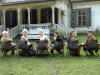
Photos from Filip Bajon's movie, based on classic drama by Aleksander Fredro

It is a portrait of Alina Margolis-Edelman, who – as a child – met Marian Falski, an author of the Polish most popular reading primer, and she appeared one of the main characters in the book. Then Alina attended The Nursing School, an unusual place in the Warsaw Ghetto. She was married to Marek Edelman, one of the leaders of the Warsaw Ghetto Uprising.

Toys takes a look at the circumstances which shaped the imaginations of today's generation of Polish artists and designers.
See also:
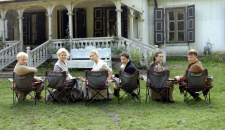
Photos from Filip Bajon's movie, based on classic drama by Aleksander Fredro
See also: